クリエイター・イン・レジデンス2025「風景のタペストリー」
佐々木蓉子レビュー
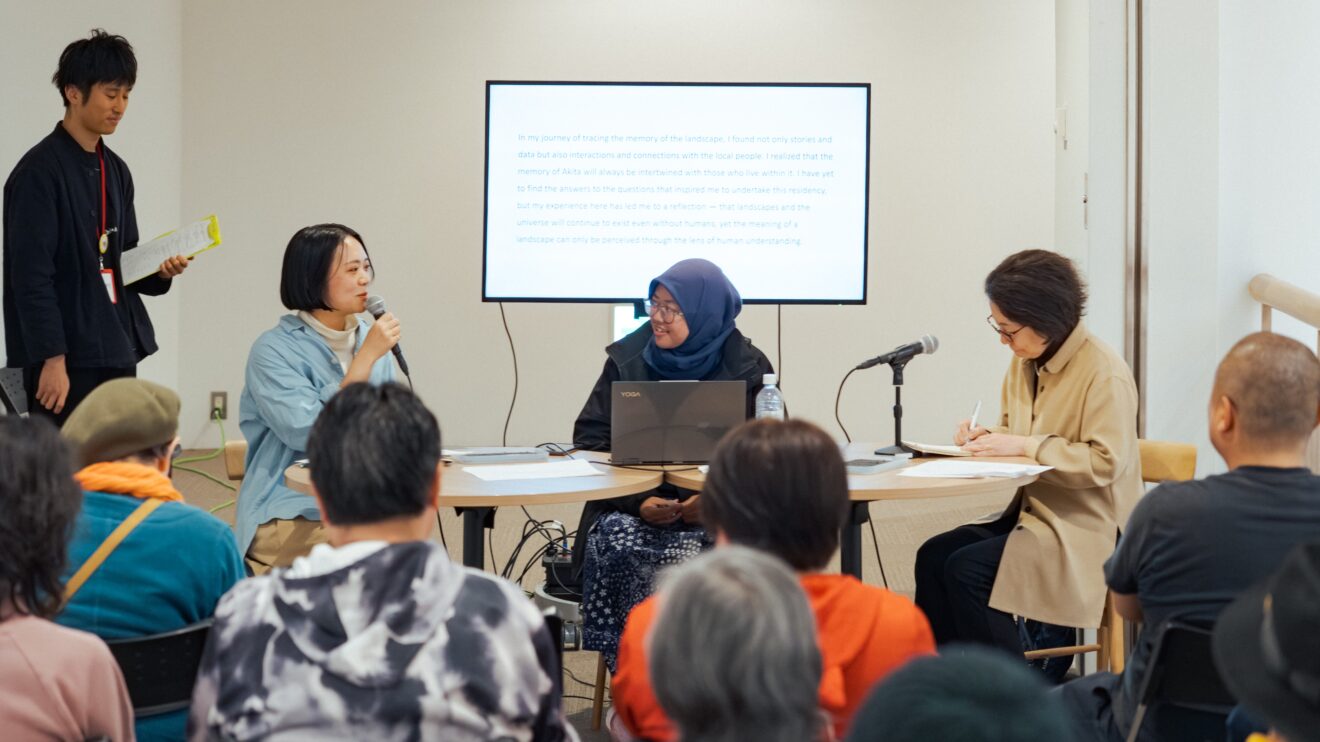
2025年9月にスタートしたクリエイター・イン・レジデンス2025。ゲストクリエイターのラクミ・フィトリアニは、10月19日から31日にかけて秋田市文化創造館内でプロジェクト「風景のタペストリー」の成果発表を行いました。10月25日に実施したアーティストトークでフィトリアニの話の聞き手を務めた佐々木蓉子が本プロジェクトをレビューします。
This article is available in Japanese and English. To read the English version, click here.
滞在期間|2025年9月〜10月
成果発表|2025年10月19日~31日
アーティストトーク|2025年10月25日
会場|秋田市文化創造館
風景の記憶を編みなおす——ラクミ・フィトリアニのレジデンスを振り返って
文=佐々木蓉子(弘前れんが倉庫美術館 アシスタント・キュレーター)
はじめに
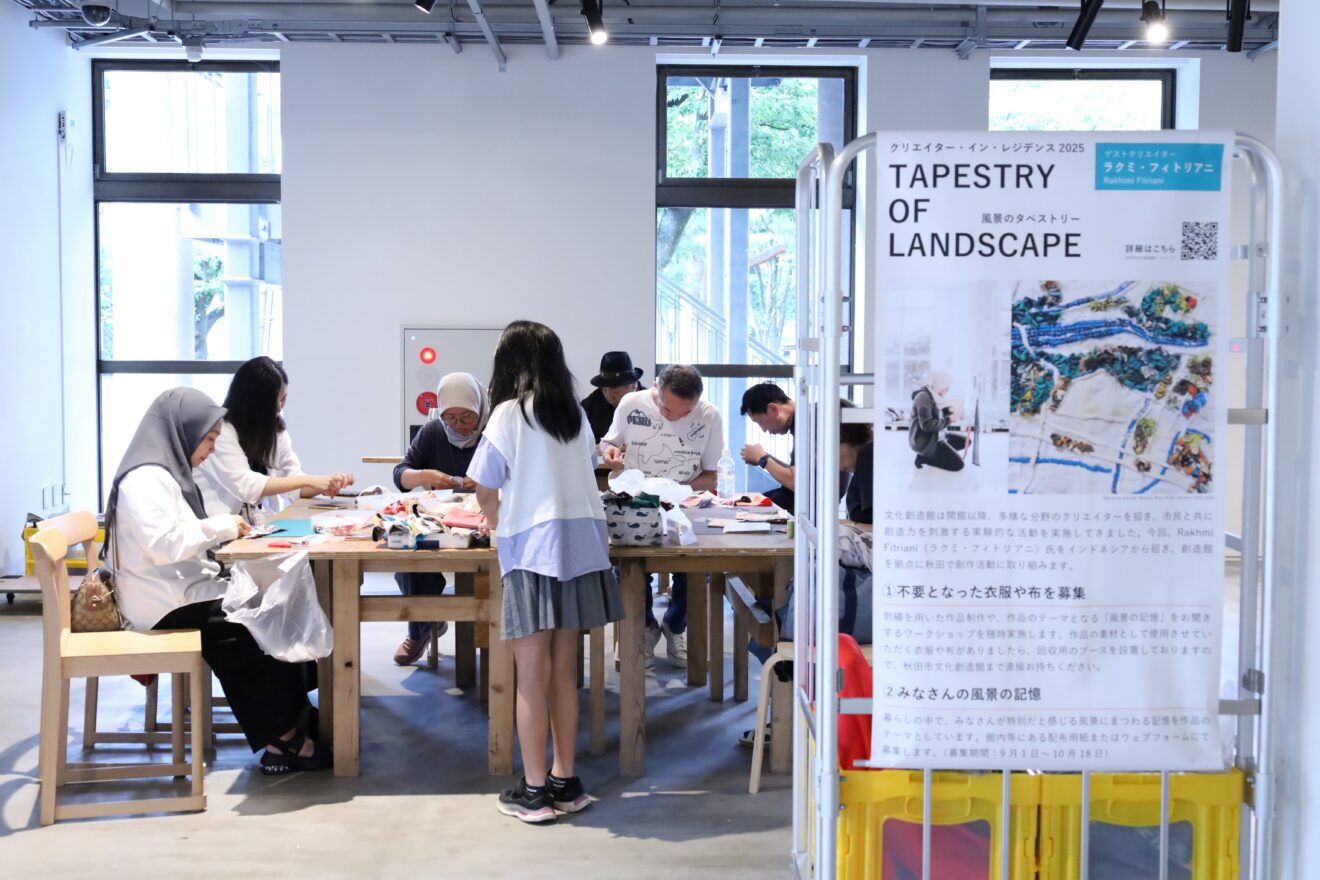
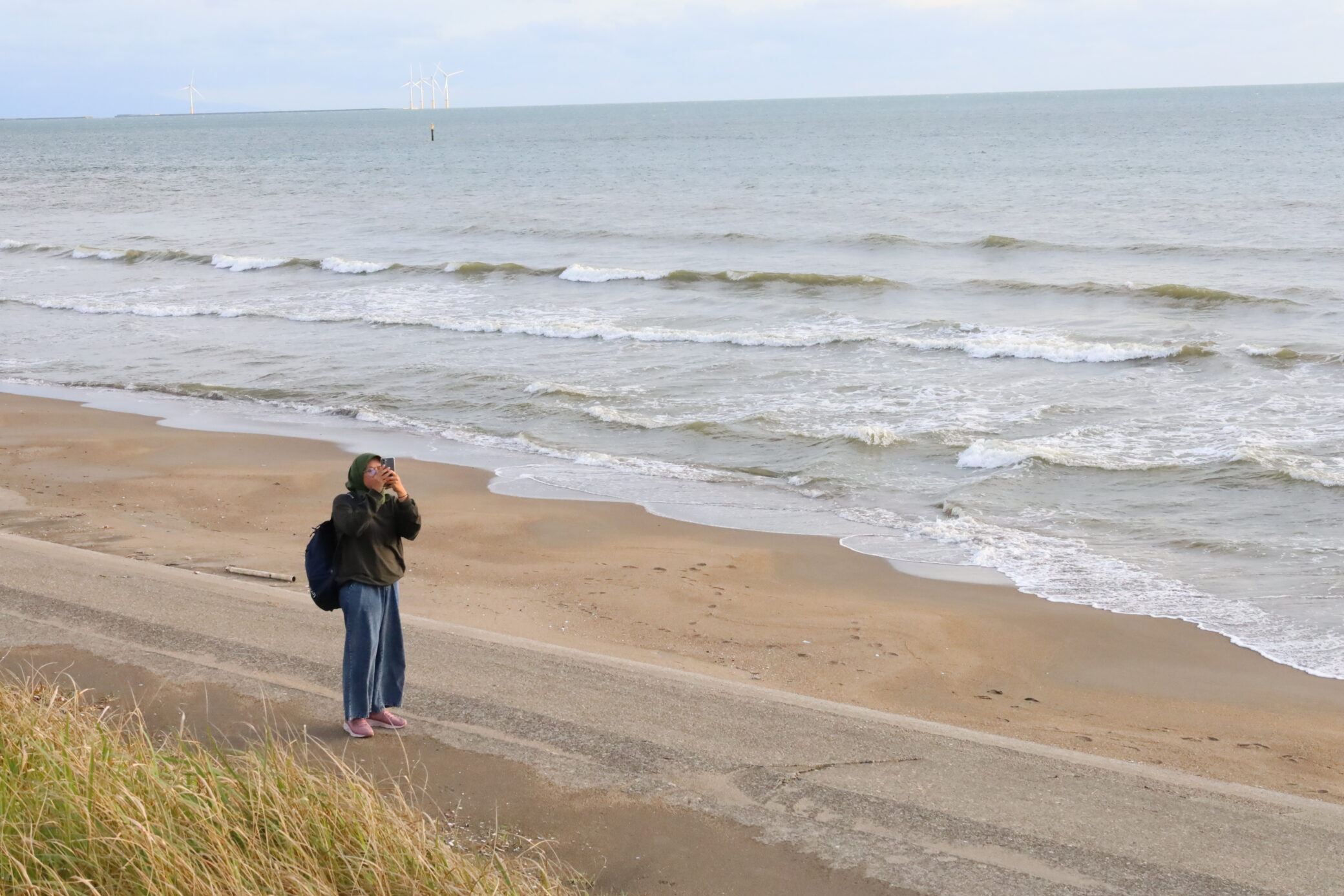
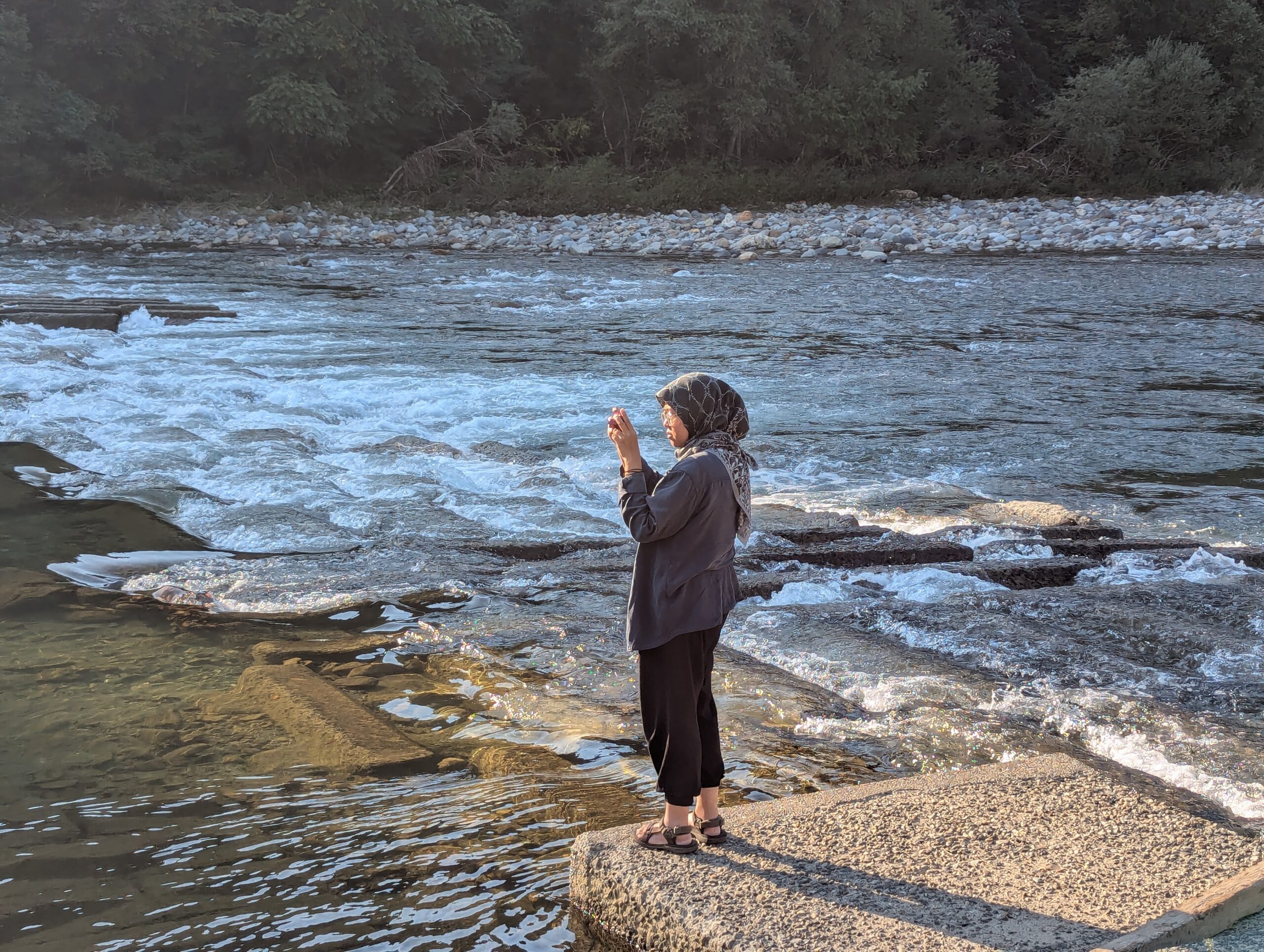
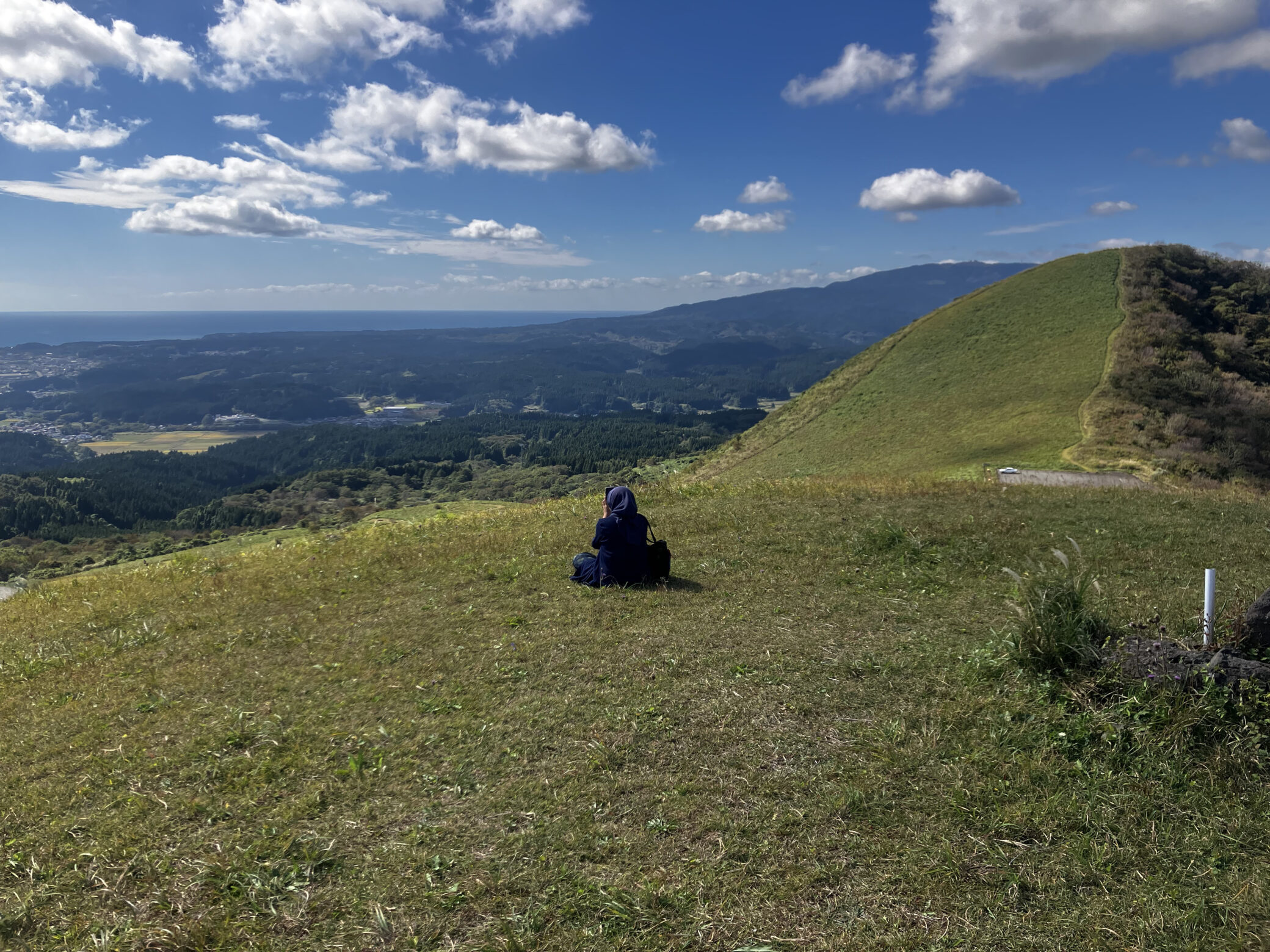
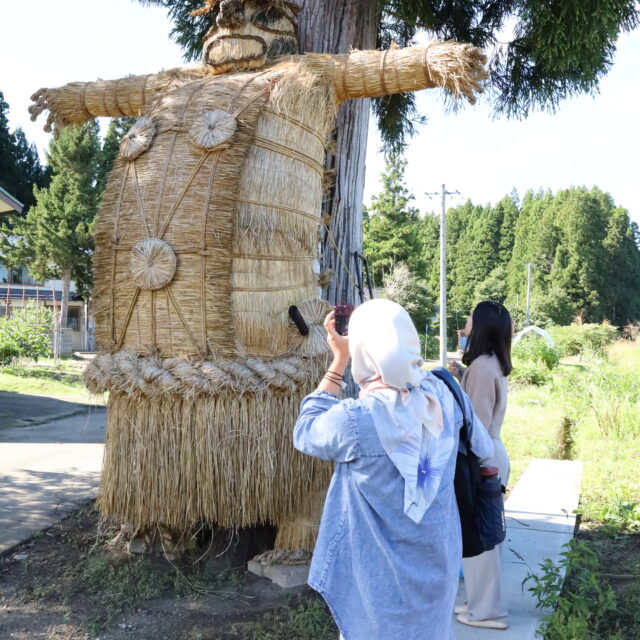
ラクミ・フィトリアニは、インドネシア・バンドン市の南に位置するパンガレンガンを拠点に活動するランドスケープアーキテクトであり、アーティストである。フィトリアニは、2025年9月から約2ヶ月間の秋田でのレジデンスにおいて、「風景のタペストリー」と名付けたプロジェクトを展開した。本プロジェクトは大きく分けて、計8回の市民との作品制作のワークショップと、その成果発表としての展示(成果展示)から成るものだ。このレポートでは、成果展示と筆者が聞き手を務めたトークイベントの内容を踏まえ、フィトリアニの秋田での活動を振り返り、その根底にある作家としての姿勢を考える。
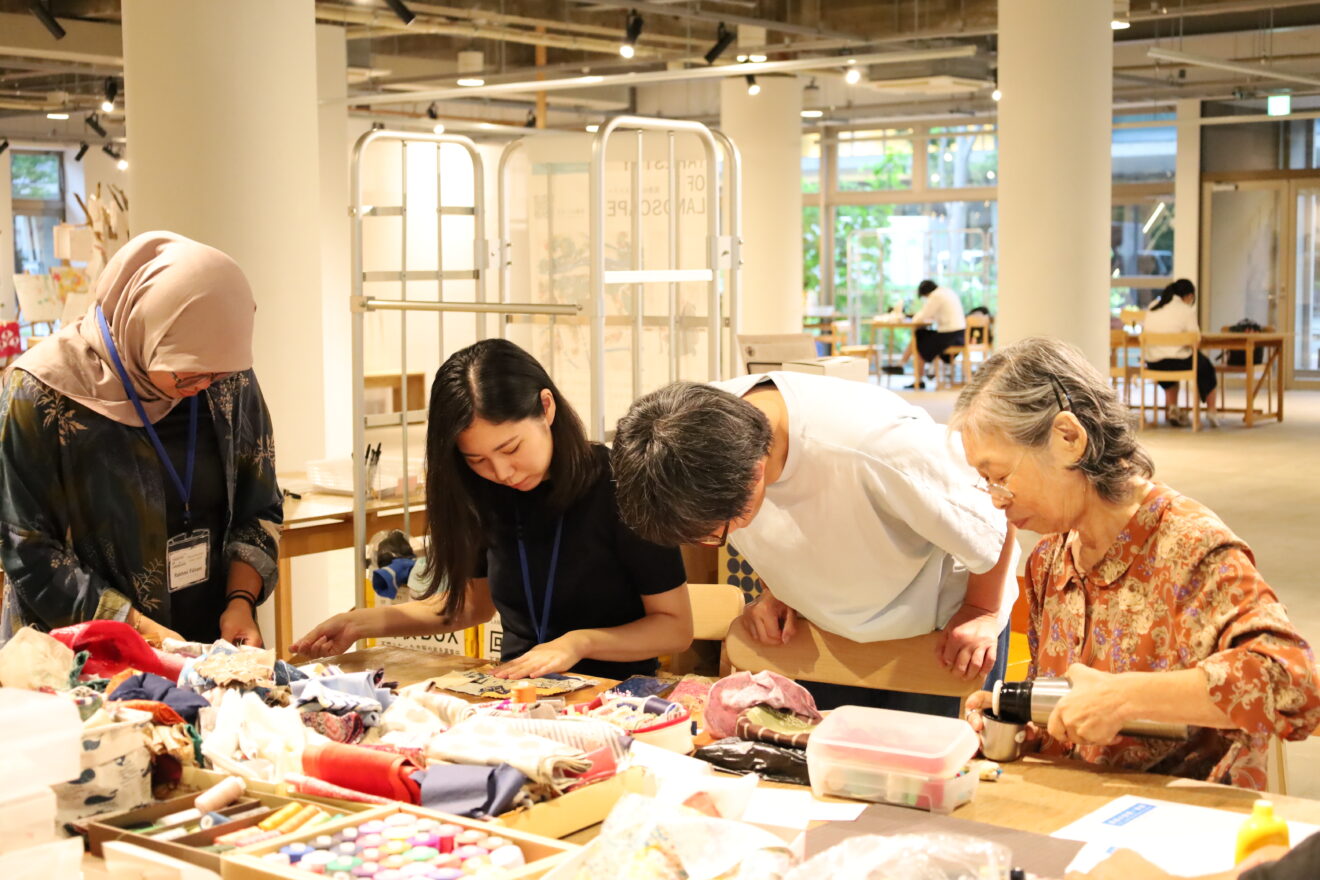
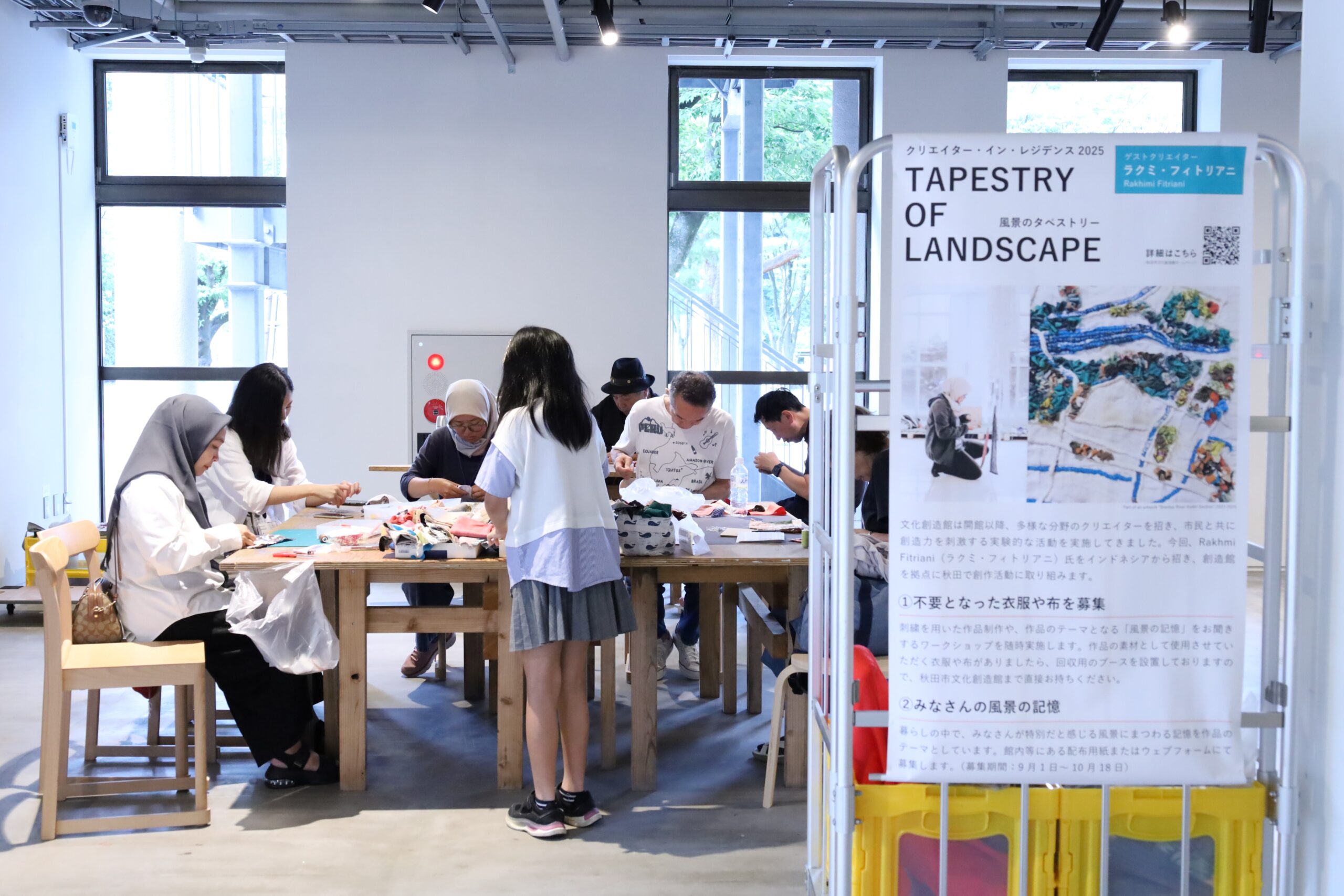
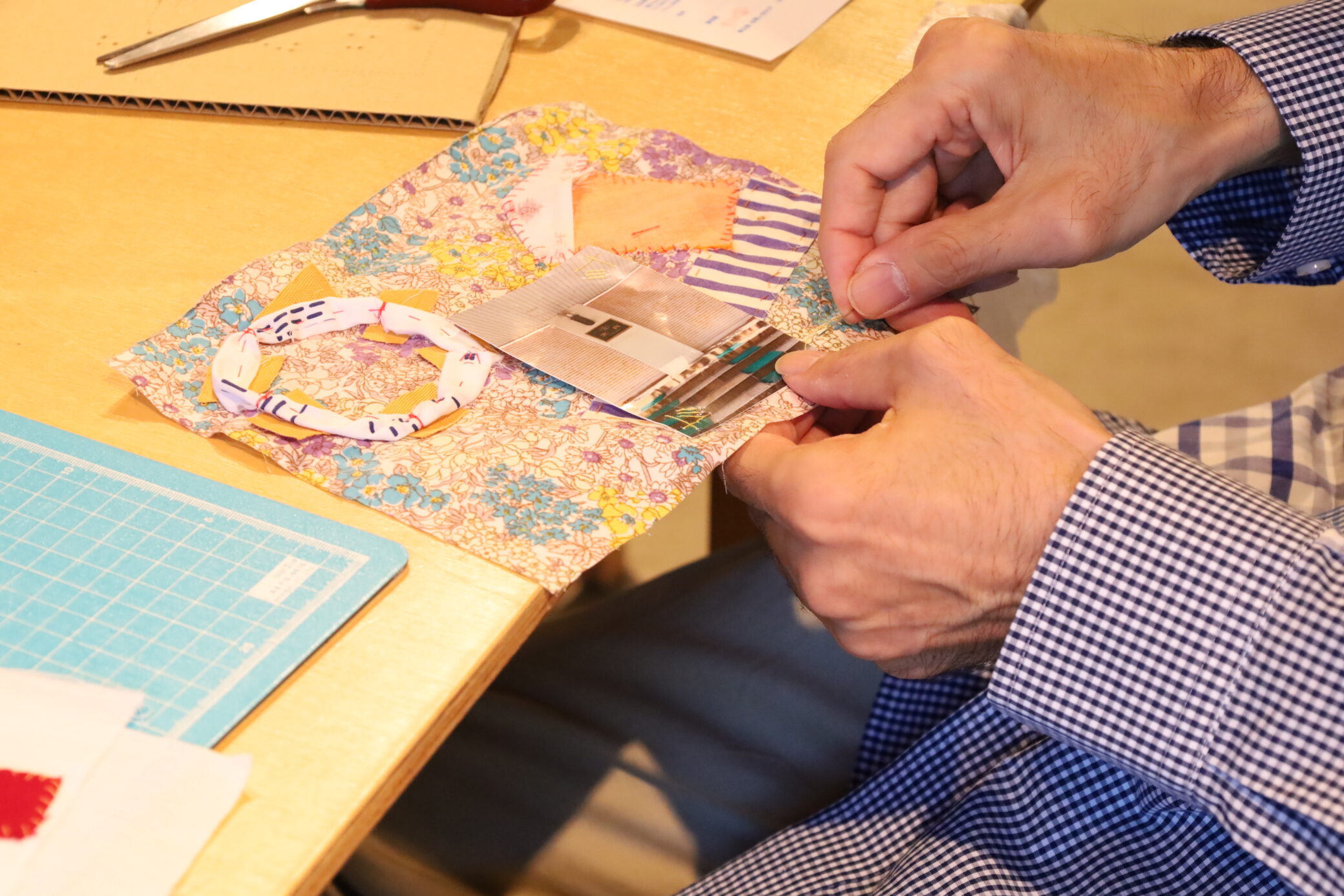
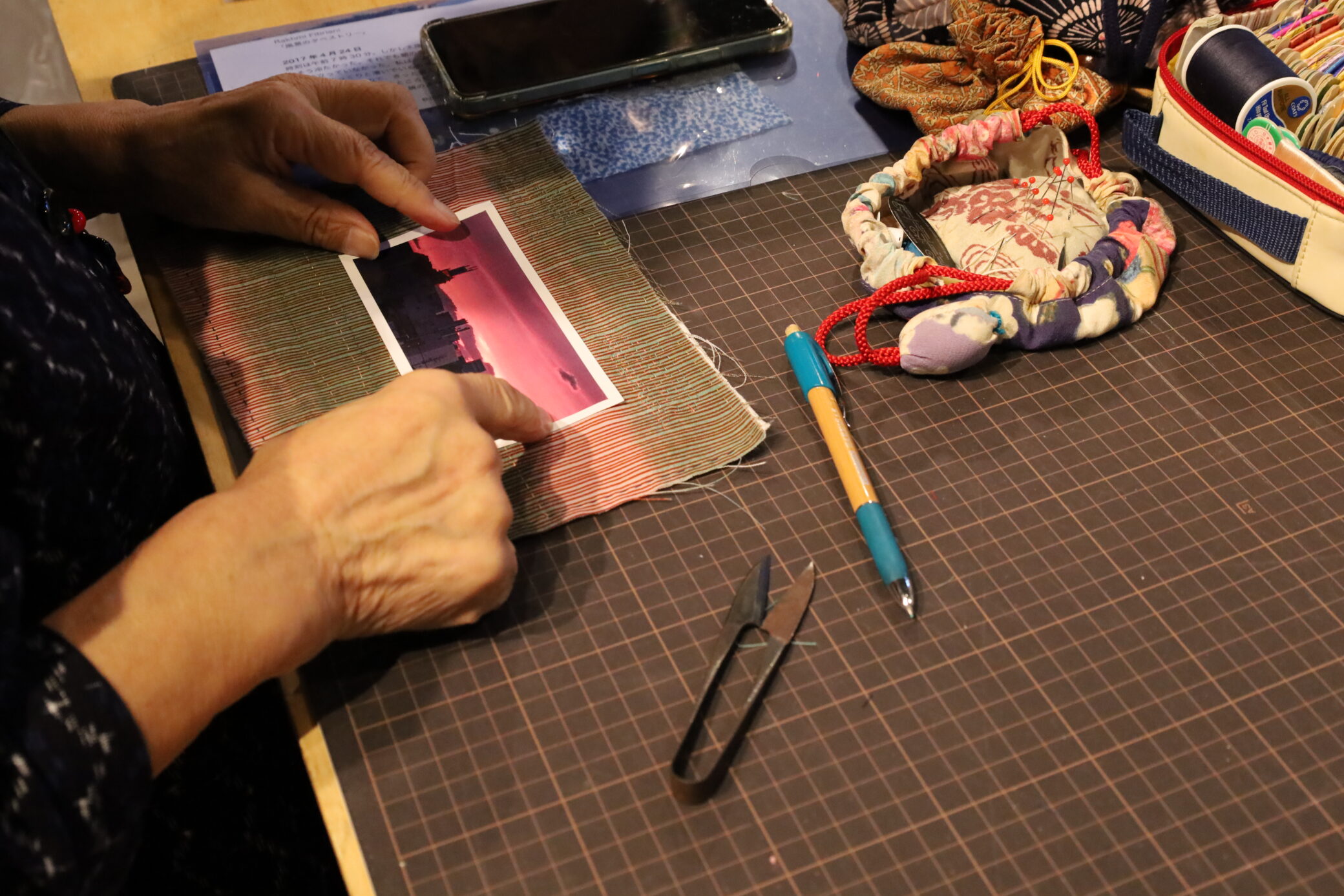
ワークショップの様子
ランドスケープアーキテクトとしての出発
フィトリアニは、アーティストとしての活動以前に、ランドスケープアーキテクトとしての経歴を持つ。ランドスケープアーキテクトとは、建設や土木といった他業種と協働し、人々の動線や植物の生育環境を考慮しながら、庭園から広場、公園にいたるまで多岐にわたる景観を設計する仕事である。フィトリアニは、2016年、インドネシアのボゴール農科大学のランドスケープアーキテクチャプログラムを卒業後、インドネシア国内のプロジェクトに携わってきた。ランドスケープアーキテクトとして風景の設計に対する知識を深める一方で、クライアントの意向に答えた風景を作り出すために自然に手を加えることで、結果として環境破壊につながってしまう葛藤も経験してきたという。その背景には、ランドスケープデザインの分野と密接に関わる、自然をコントロール可能な対象として捉える西洋的自然観がある。こうした西洋的な自然観と、アーティストとしてフィトリアニが考える「人間と自然の関係性」との間にずれが生じたこと、くわえて、ランドスケープアーキテクトに求められる土壌や気候などに関する科学的な知見を超え、より多層的に世界を捉えたいと感じたことが、アーティストの道へと進む契機となった。
風景のタペストリー
本レジデンスでフィトリアニがテーマとした「風景の記憶」のアイディアは、ショウリデ・C・モラヴィの著作『Environmental Warfare in Gaza(ガザにおける環境戦争)』(2024年、Pluto Press)が着想源となっている。本書は、紛争が続くガザ地区において、軍による自然環境への関与が、いかにガザの土地を作り替えてきたかを考察する内容である。フィトリアニは、本書の読書体験を通して、「風景と人間との相互作用は、コミュニティの記憶、文化、習慣、そして価値観をどのように形作っているのか」という問いを立てた。
フィトリアニは、2019年より刺繍や編み物を手法とした作品制作を行ってきた。今回のプロジェクトでも、主として手芸の手法が用いられている。彼女にとって、手芸は幼少期から身近な存在であった。母親に買ってもらった人形の服を手縫いで作った経験が創作の原体験であり、大学生の頃には独学で編み物を楽しんだという。くわえて、糸や布といった素材そのものは、ランドスケープアーキテクトとして向き合ってきた風景を構成する自然の一部である「植物」を原料としている。この点も、彼女が刺繍を用いる重要な理由であるという。
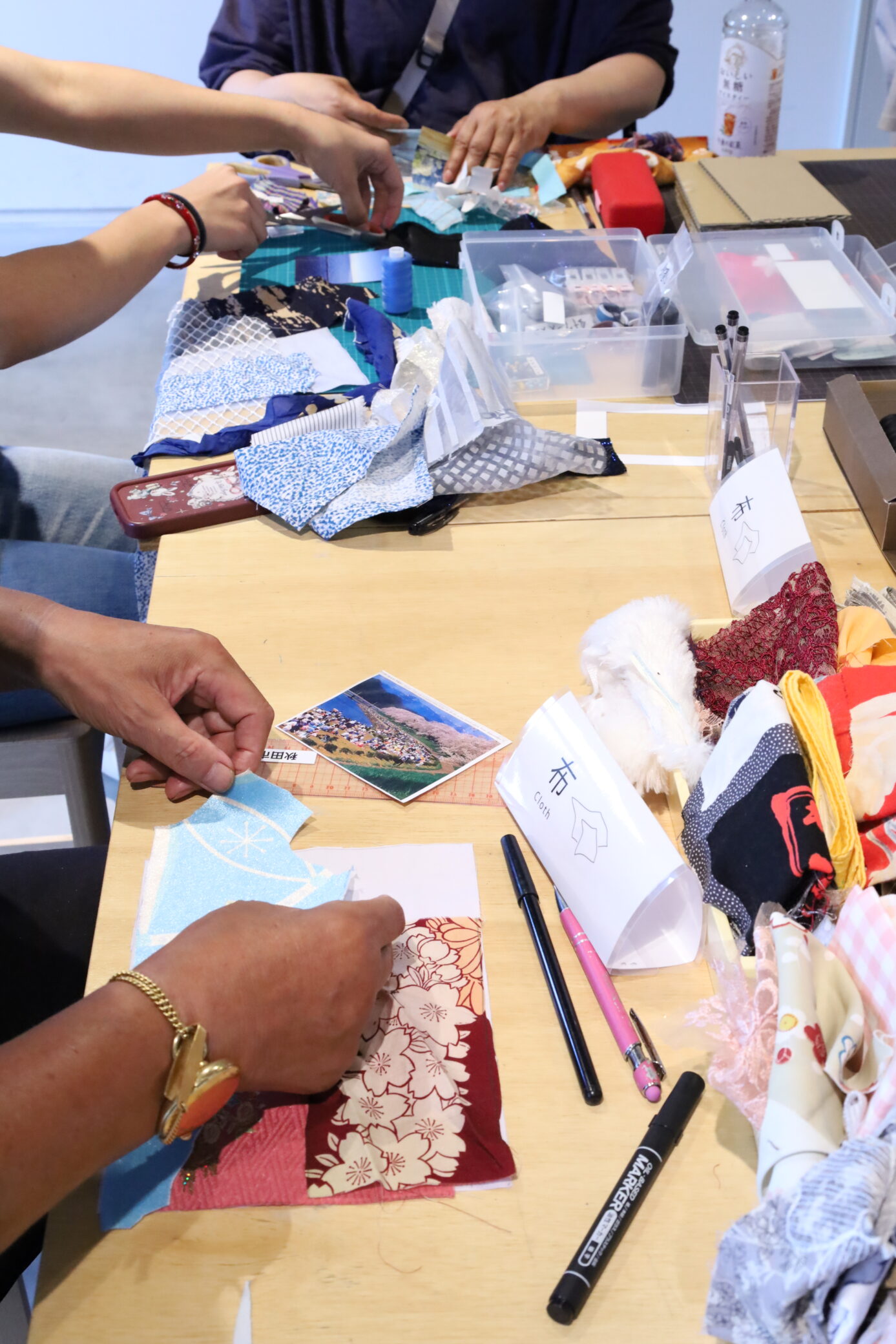
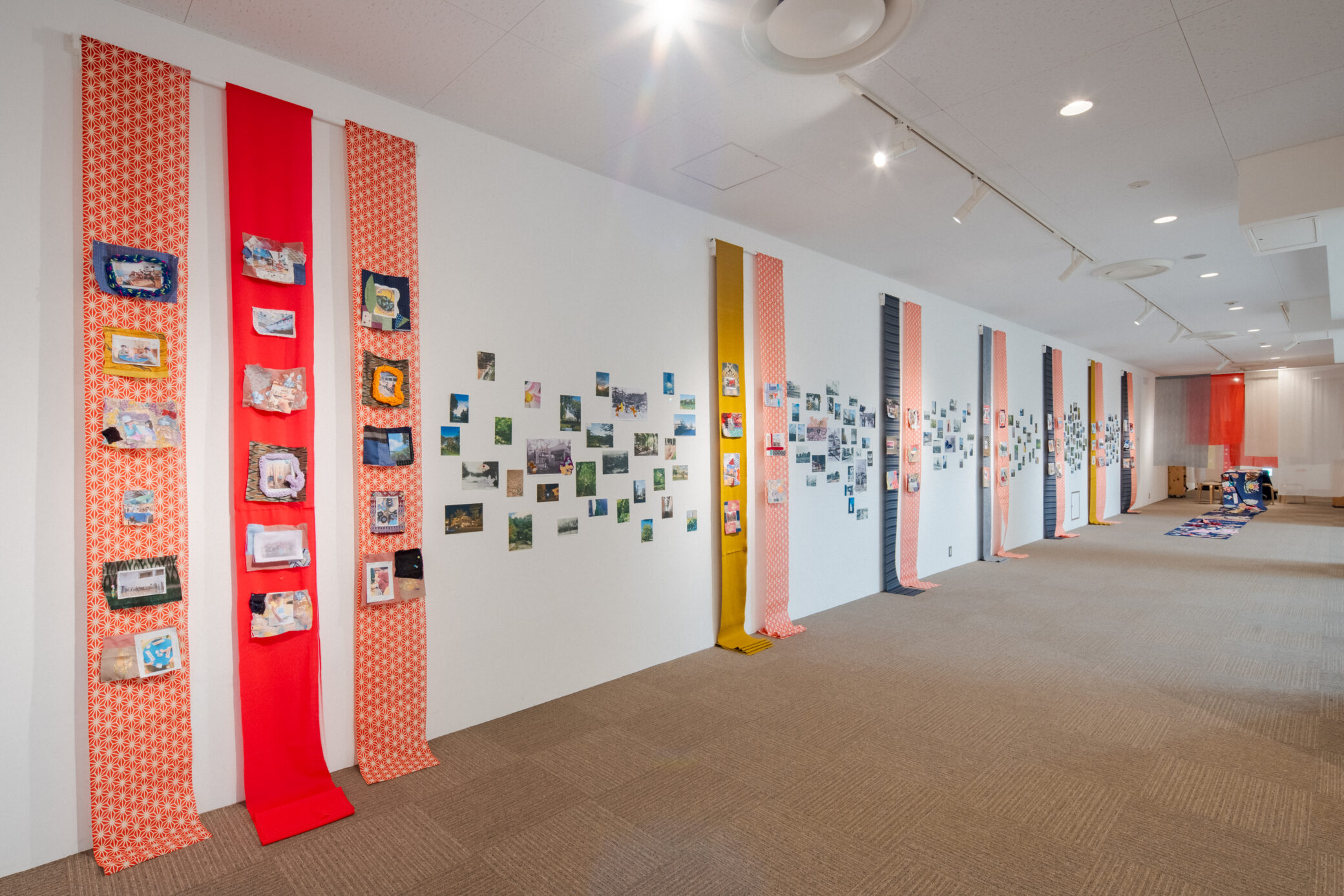
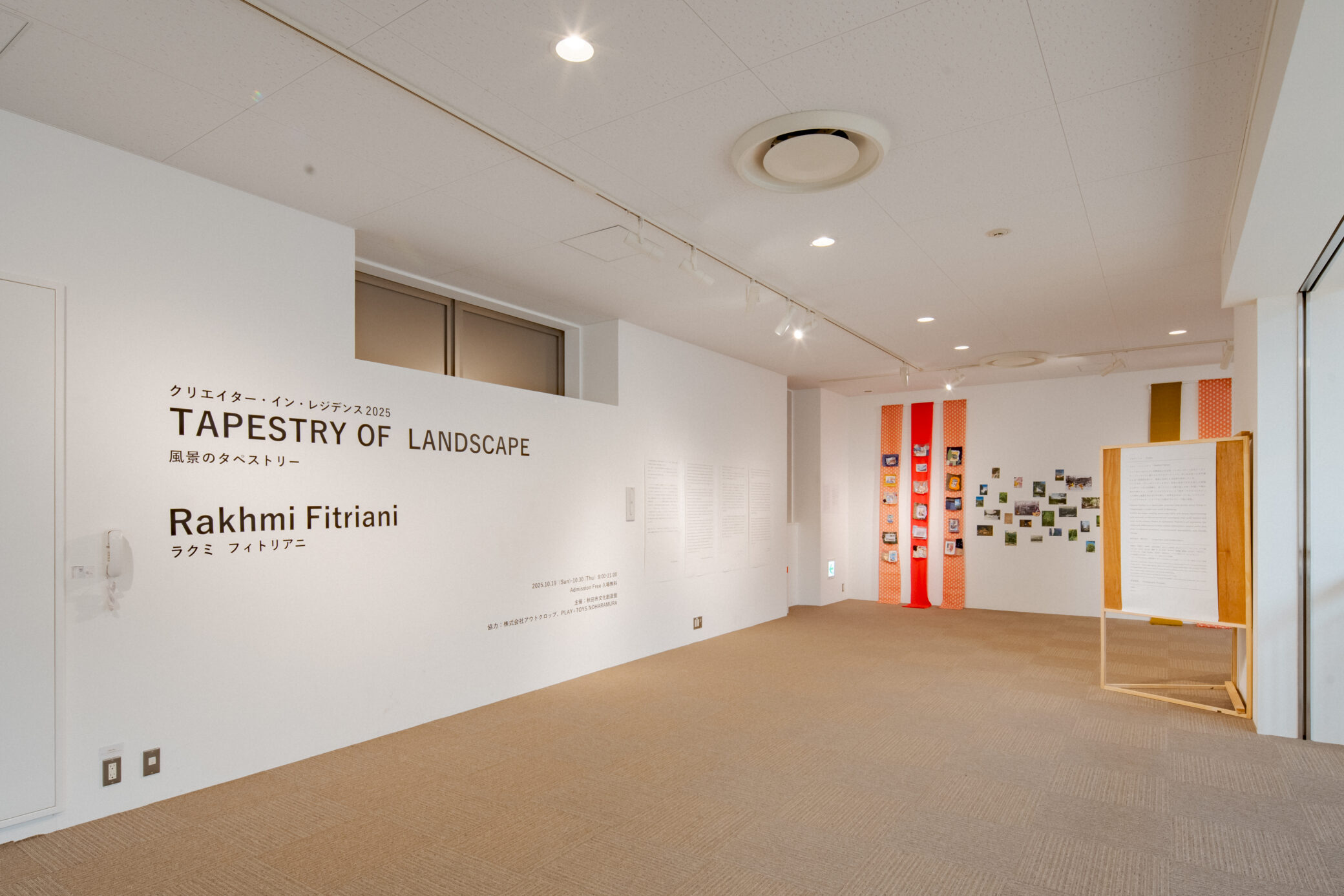
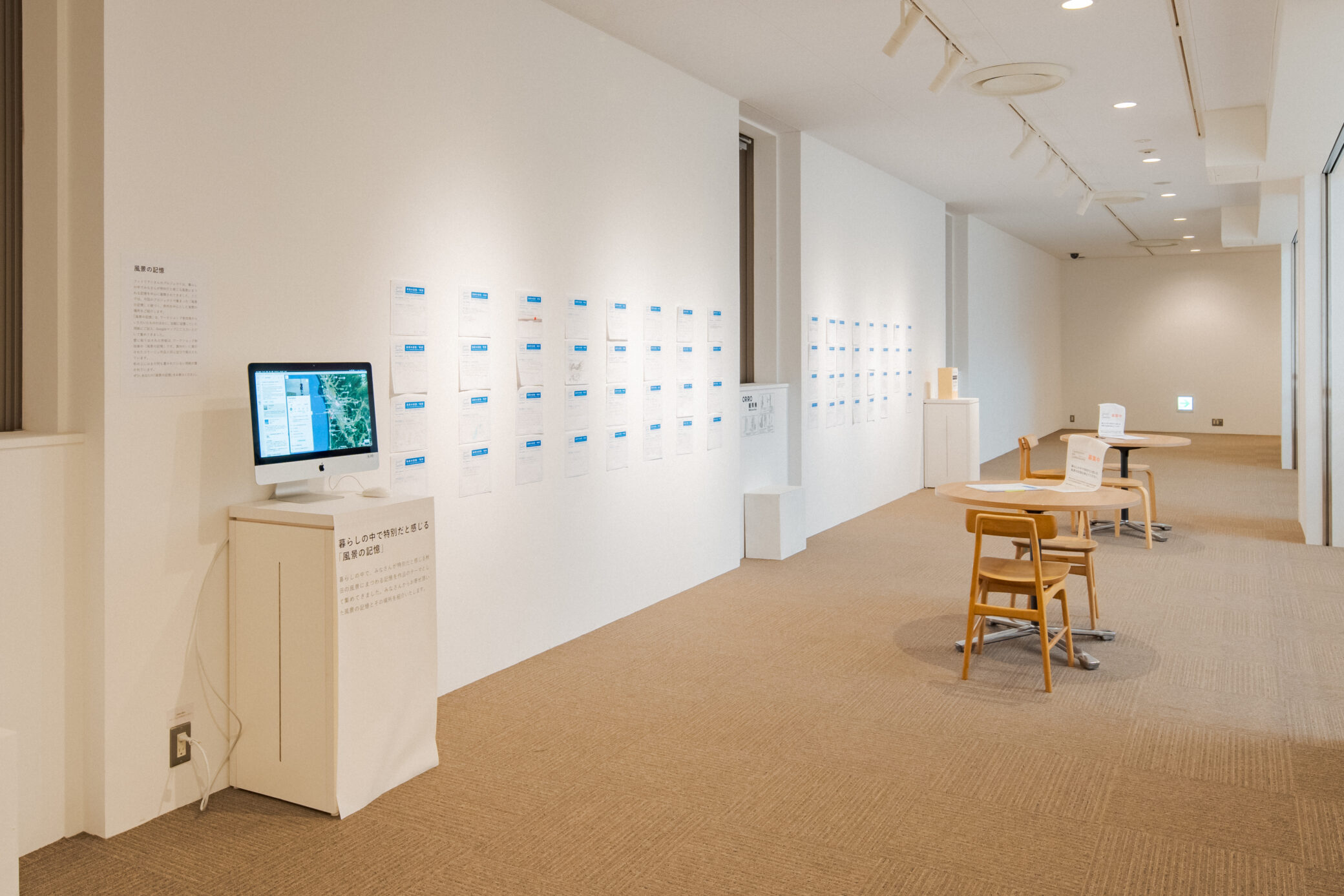
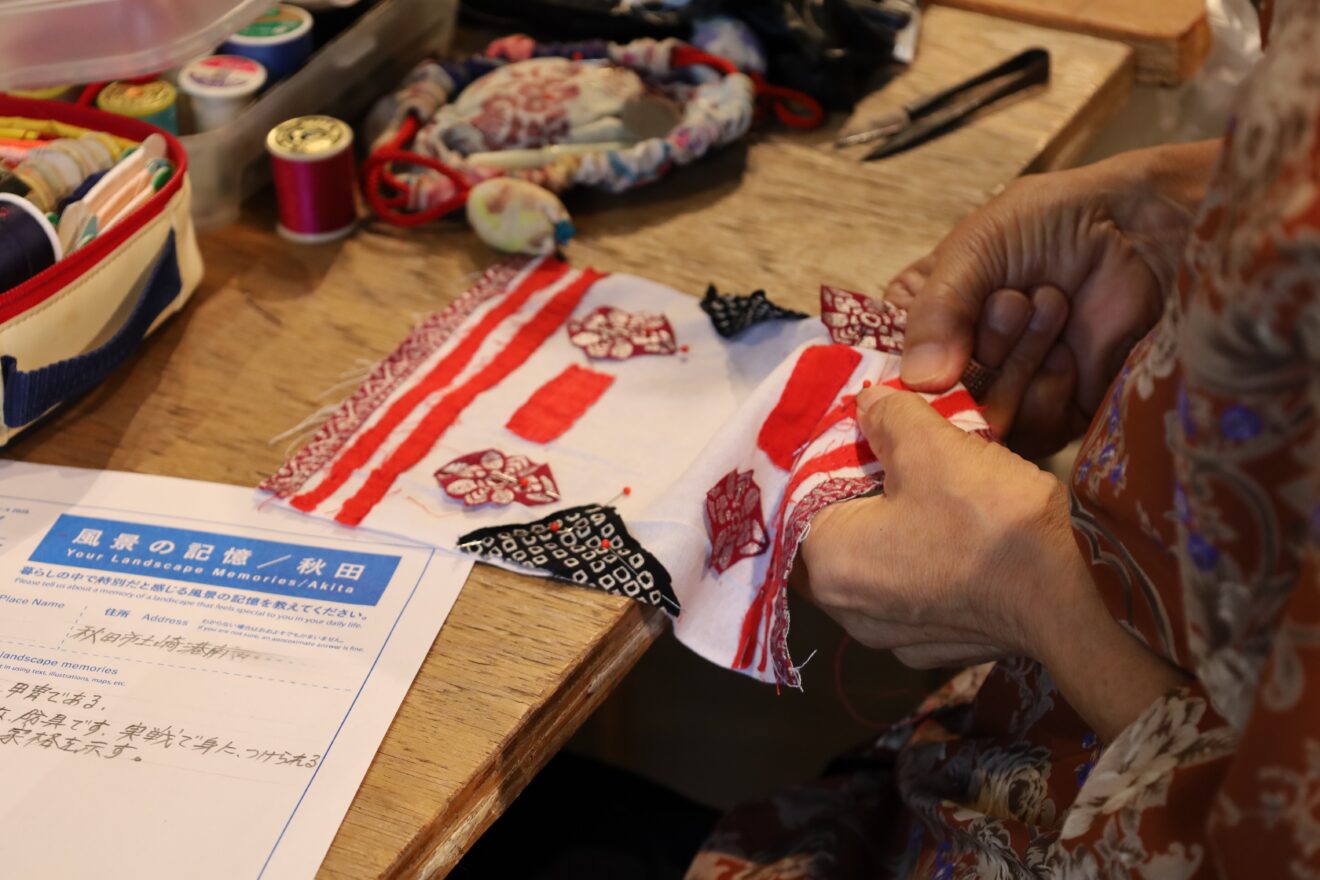
今回の成果展示のスペースは、秋田市文化創造館3階の回廊状の展示空間スタジオA3である。順路の最初に現れる壁面では、ワークショップに参加した市民によるコラージュ作品で構成された「風景のタペストリー」が展開された。述べ59名の参加者が、思い入れのある風景の写真を持ち寄り、フィトリアニと交流しながら、コラージュを制作した。素材として使用された古い布や衣服も、市民が持ち寄ったものだ。フィトリアニは、人々から提供された布を、その人と共に秋田の風景を体験した特別な素材として捉えている。紙に出力した写真の上に直接ステッチを施したもの、写真の周囲に質感の異なるはぎれをフレーム状に縫い合わせたものなど、さまざまな作品が生まれた。
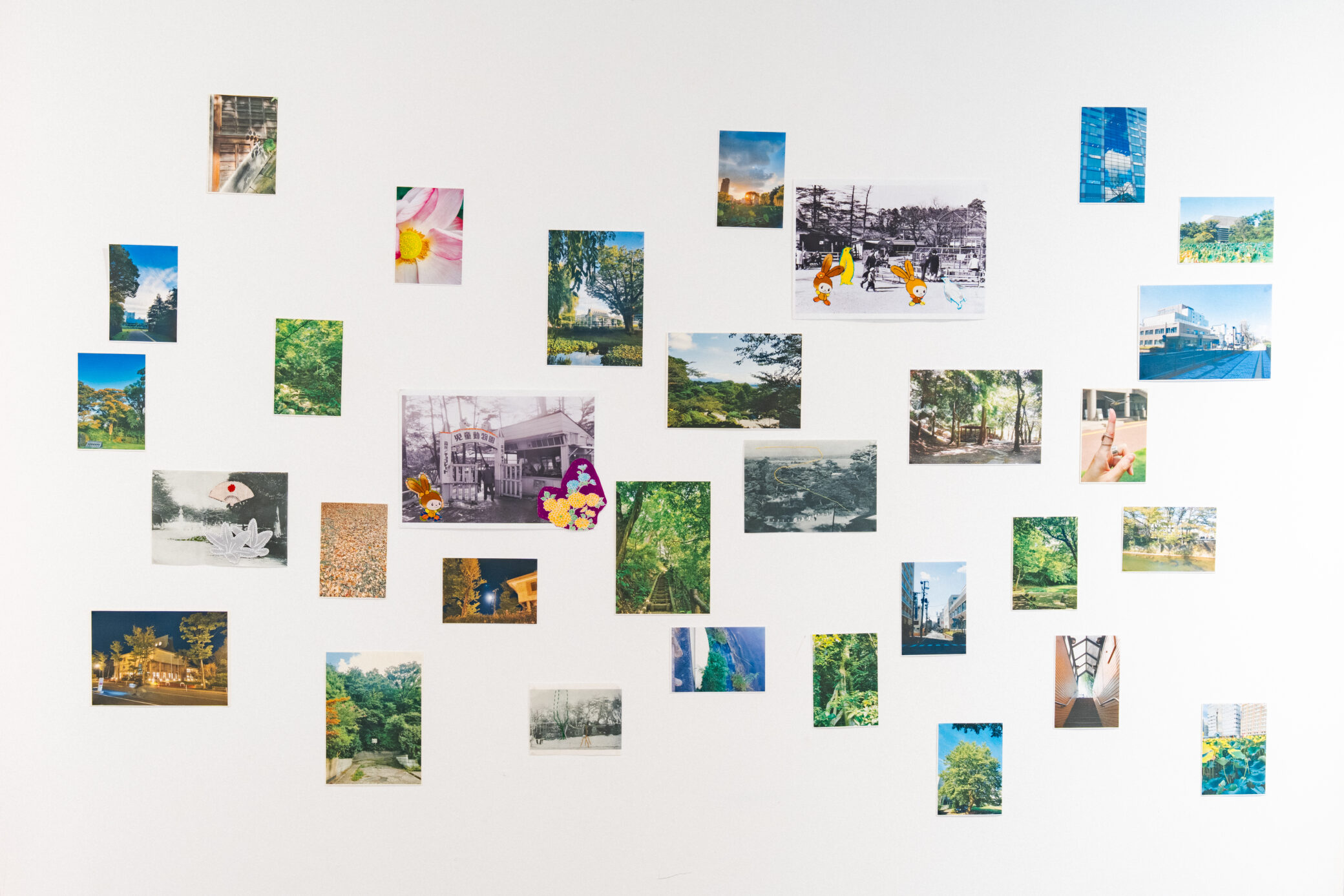
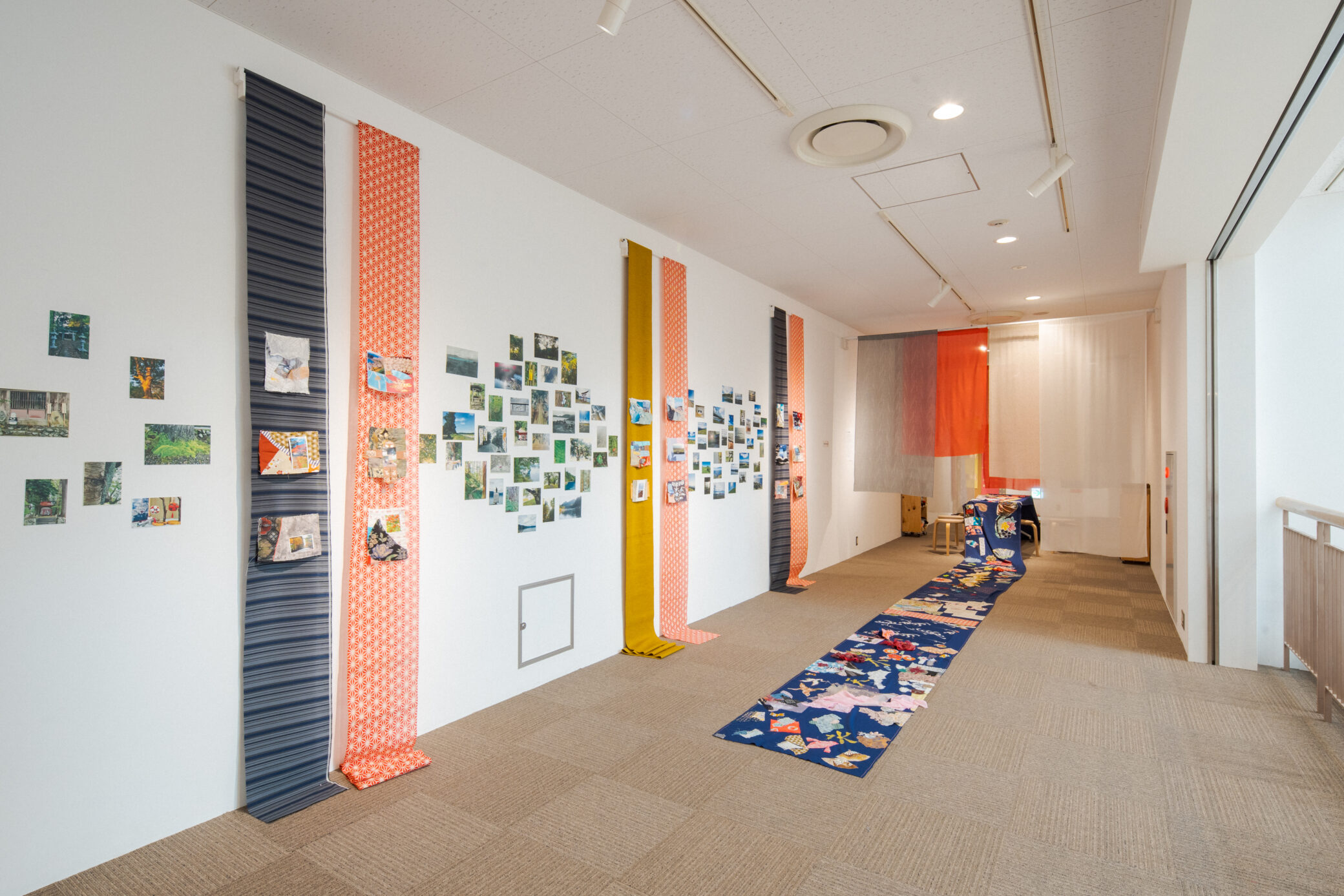
コラージュ作品の間には、参加者から寄せられた「風景の記憶」にまつわる場所でフィトリアニが撮影した現在の写真とともに、過去に写された写真が展示された。過去の風景の写真は、明治期から昭和期にわたるもので、作家自身が図書館などを通じて郷土資料から探し出した。壁面ではたとえば、秋田市文化創造館からほど近い、千秋公園内から見える現在の秋田市街地の眺めと、昭和期の同じ場所からの眺めがおさめられた写真が並んだ。この昭和期の写真の上には、曲がりくねった道のような黄色いステッチが軽やかに走り、過去と、縫い手がいる現在とを繋いでいるように見えてくる。このほかにも、明治期創業の老舗百貨店「木内(きのうち)百貨店」をはじめ、市民にとって馴染み深い施設から郊外の自然まで、様々な場所の写真が展示された。
フィトリアニは、写真とともに、秋田の風景にまつわるエピソード、すなわち、「風景の記憶」の提供をワークショップ参加者以外にも呼びかけた。寄せられたエピソードの総数は最終的に72箇所にのぼった。成果展示の順路の終盤で参加者手書きのシートが紹介されたほか、Google Mapsでも公開された。フィトリアニにとって、このプロジェクトは、秋田の人々の風景の記憶をマッピングする作業であった。「木内百貨店」のように、複数の参加者から写真が寄せられた例もあり、個人の風景の記憶が重なり、街の集合的な記憶が織りなされていくありようが示された。作家は、これを長い時間をかけてひとつのタペストリーが織りなされるプロセスに重ね合わせ、視覚的に示すことを試みた。
撮影:星野 慧
撮影:星野 慧
流れる水の時間
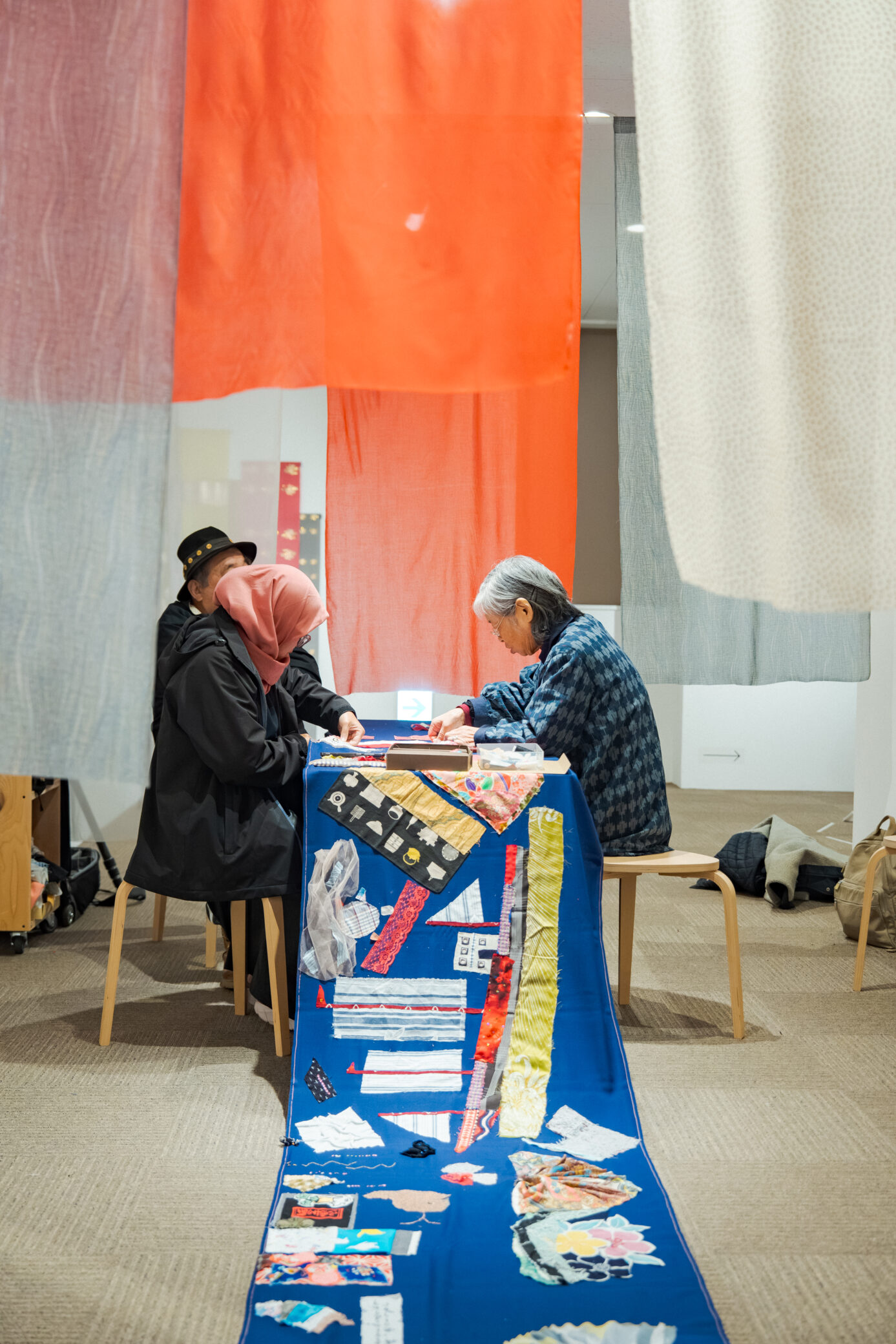
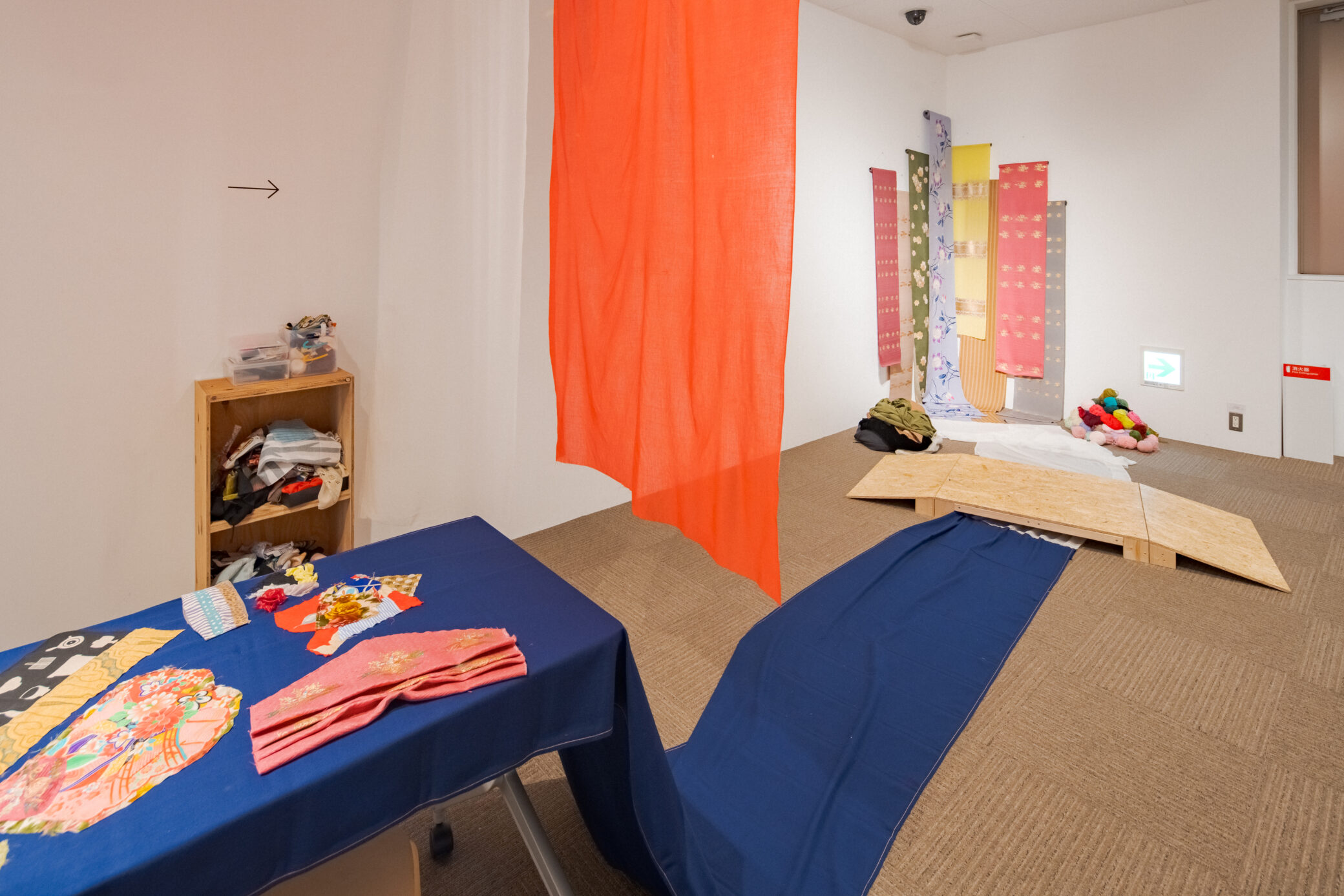
「風景のタペストリー」の展示の先には、透きとおるような薄い素材の布が数枚、天井からカーテンのように吊られ、空間がゆるやかに区切られたスペースがある。ここには、フィトリアニと市民がともに作業するための机と椅子が設えられた。机の上にはロール状の青い布が広げられ、手芸用の素材や道具が準備されている。展示期間中、フィトリアニは定期的にこの場所を訪れ、市民と交流を重ねた。作家が不在の時間にも市民が自然と集まり、談笑しながら針と糸で刺繍を施した。机の上に広げられた分の布が装飾で埋まると、青い布は少しずつ送り出され、川の流れを思わせるように、床の上に直線的に配された。
撮影:星野 慧
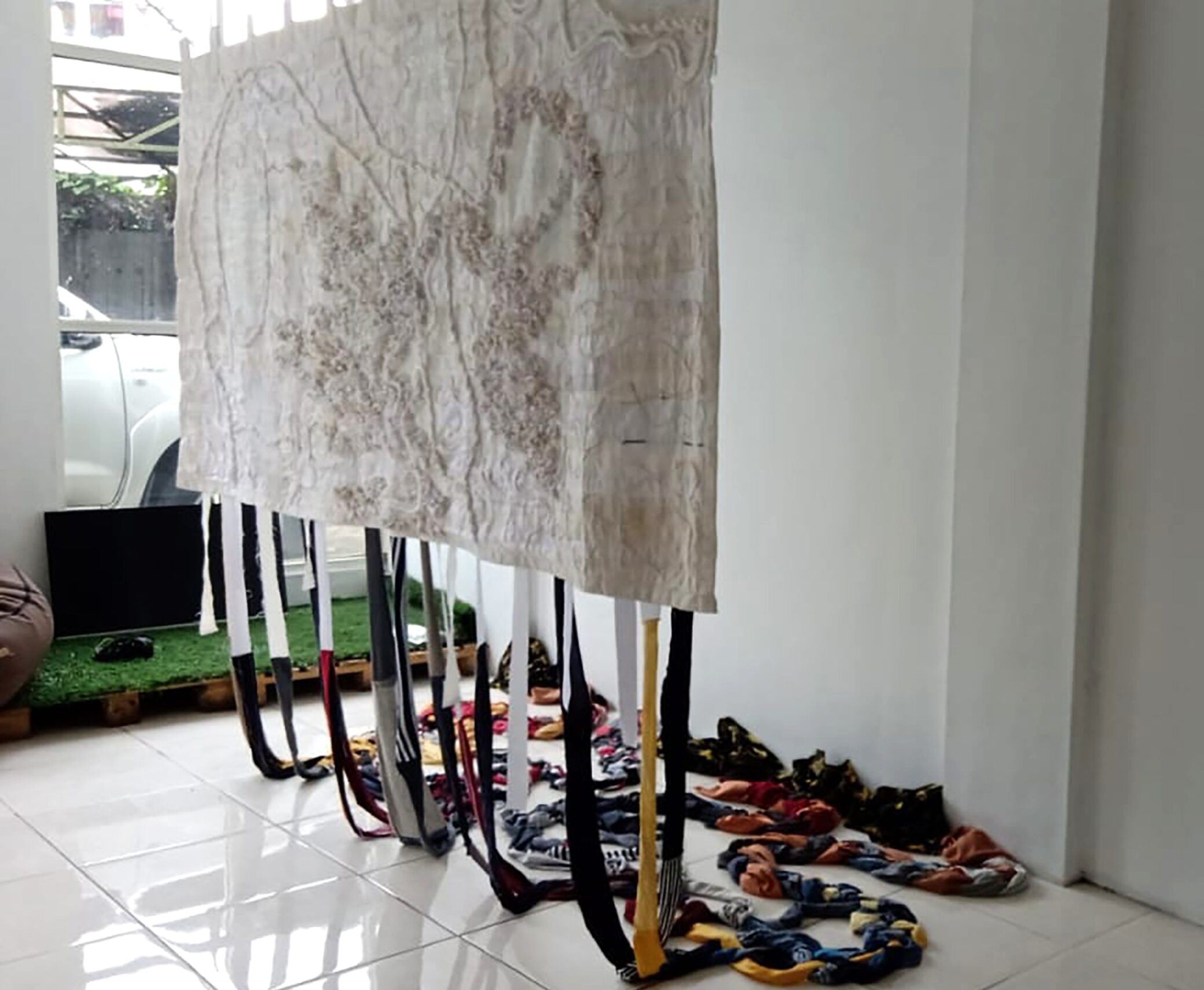
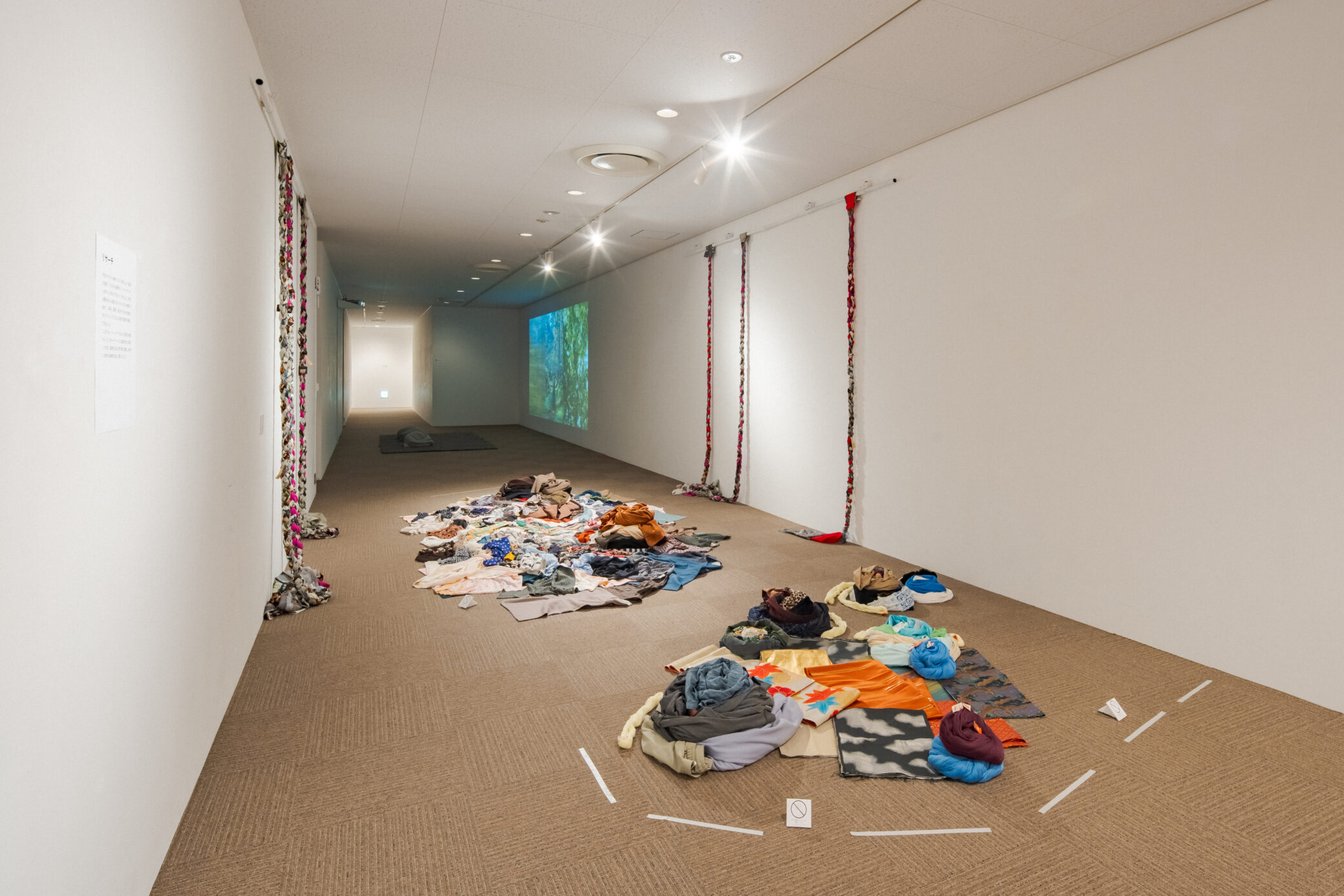
この共同制作スペースを抜けると、壁にそって天井に近い位置から長い布が重ねられて下がり、滝の流れを再現した一角が現れる。この滝のイメージは、人々から寄せられた風景の記憶の中に、秋田県にかほ市の「元滝伏流水」のエピソードがあったことから着想を得たものだという。さらに、近くの床面には、秋田市内を流れる雄物(おもの)川、旭川、太平川、岩見川といった河川の形状を辿るように布が配され、大地の地図のように展開された。その周囲の壁面には古布を裂いて編み込んだ造形が伝い、空間全体でうねるような川の流れが表現された。滝と川は山の中の同じ源泉を共有することから、ひとつの展示空間で、両者が繋がりをもつものとして関係付けられている。
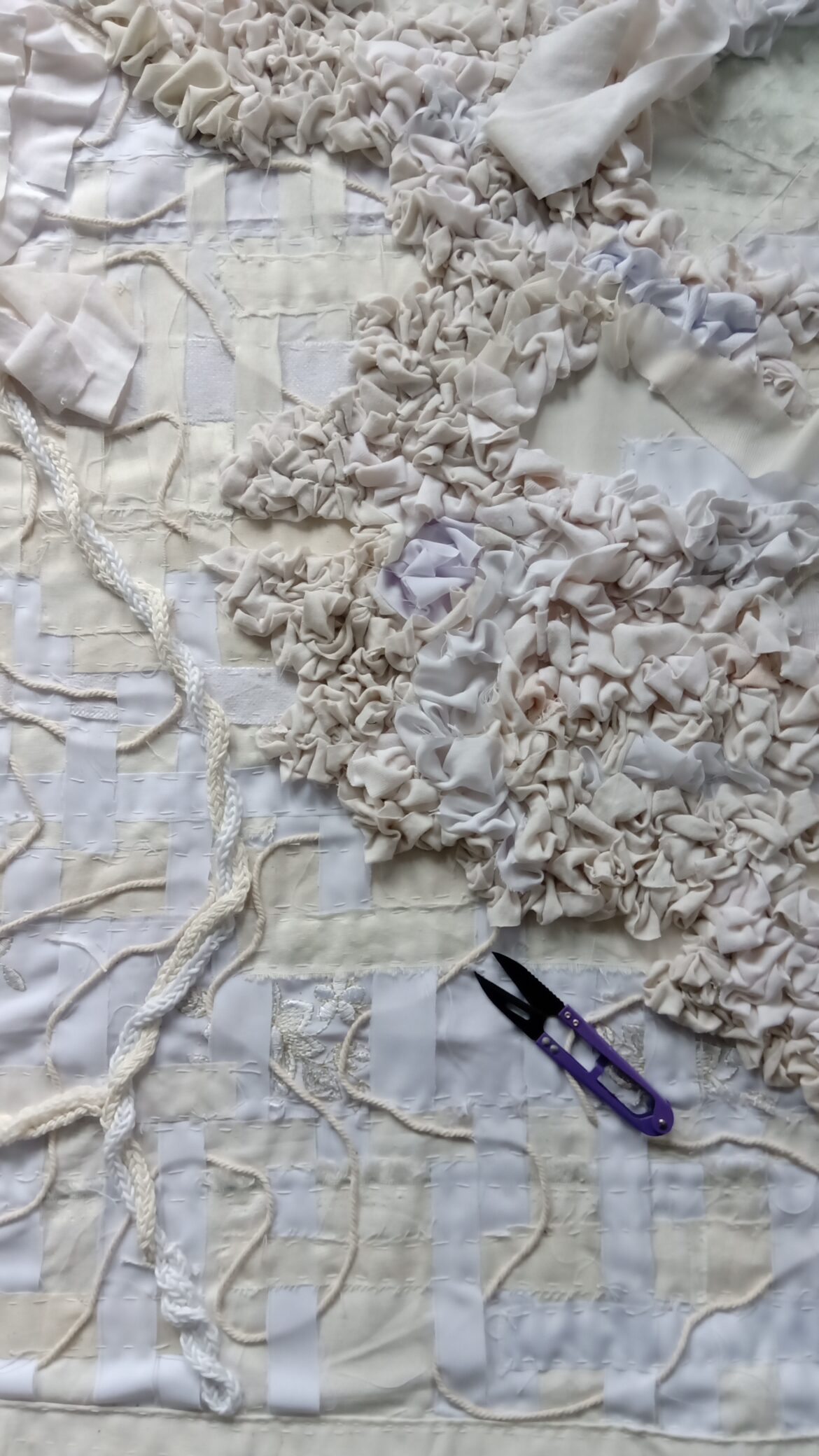
こうした「流れる水」のイメージは、フィトリアニが自身の作品の中で繰り返し取り入れてきたものだ。例えば、2022年の作品《Living Water(生きた水)》は、インドネシアのジョグジャカルタでのレジデンスに際して制作された。同地の自然保護区周辺における観光開発や農業による環境変化が、湧水や湖の流れを変え、人々の暮らしに影響を及ぼしている状況に着目した作品である。布と毛糸が素材として用いられ、変化を遂げてきた複雑な水の流れが、緻密な刺繍で表現されている。フィトリアニにとってある土地を流れる水は、地域住民の生活に密接に関わるものであり、自然と人間の相互作用を象徴する存在である。くわえて、流れる水と手芸の技法は、彼女のなかで、時間の感覚の点でも結びついている。フィトリアニは、布に針を通すときの下から上へ、上から下へと繰り返される身体の動きに、円環的でゆらぎのある時間の流れを感じるという。手芸の行為における時間のあり方は、上下に波打ちながら絶えず進んでいく水の流れと共鳴するものとして捉えられている。
撮影: Mochamad Alvi
写真提供:Rakhmi Fitriani
記憶の交換
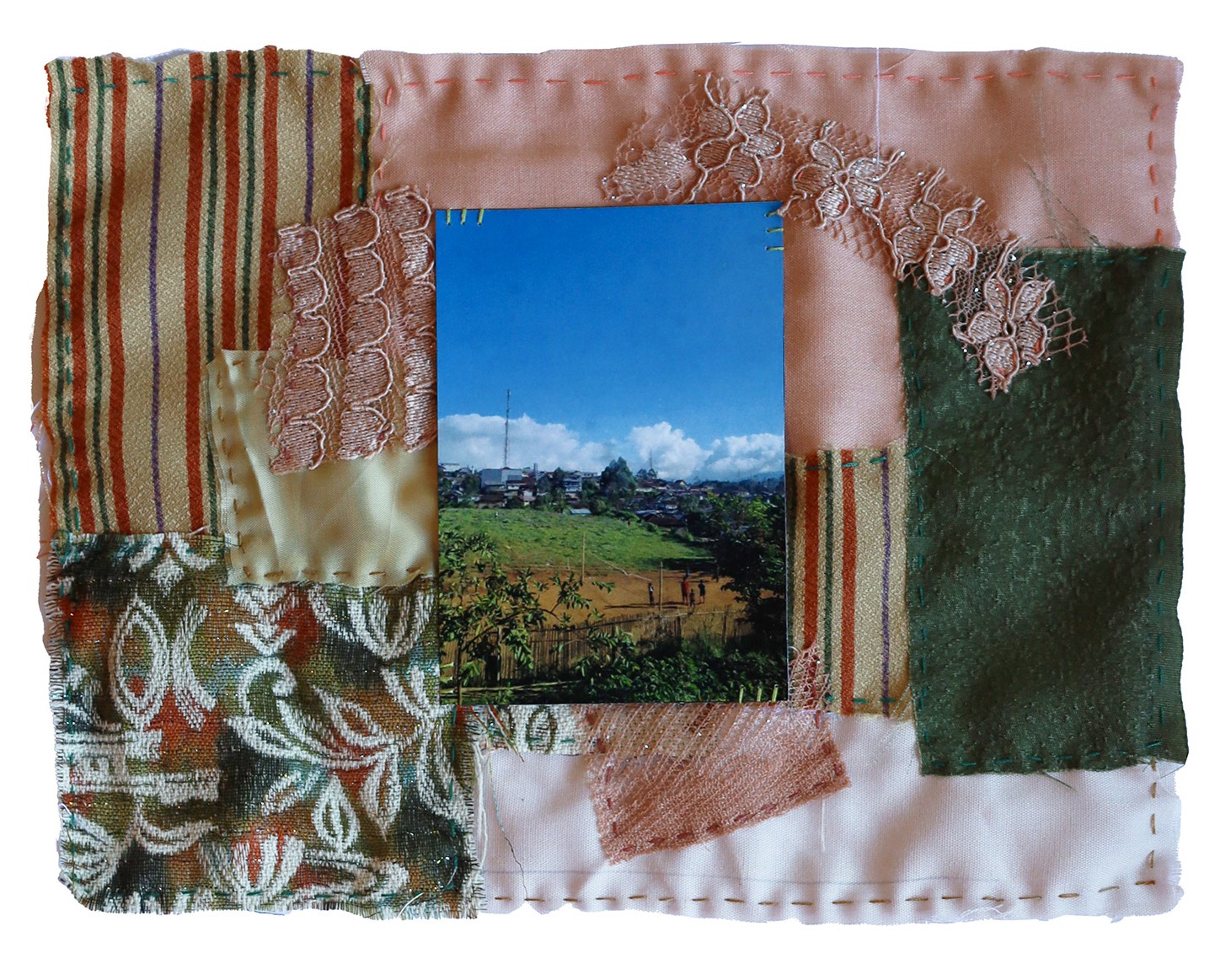
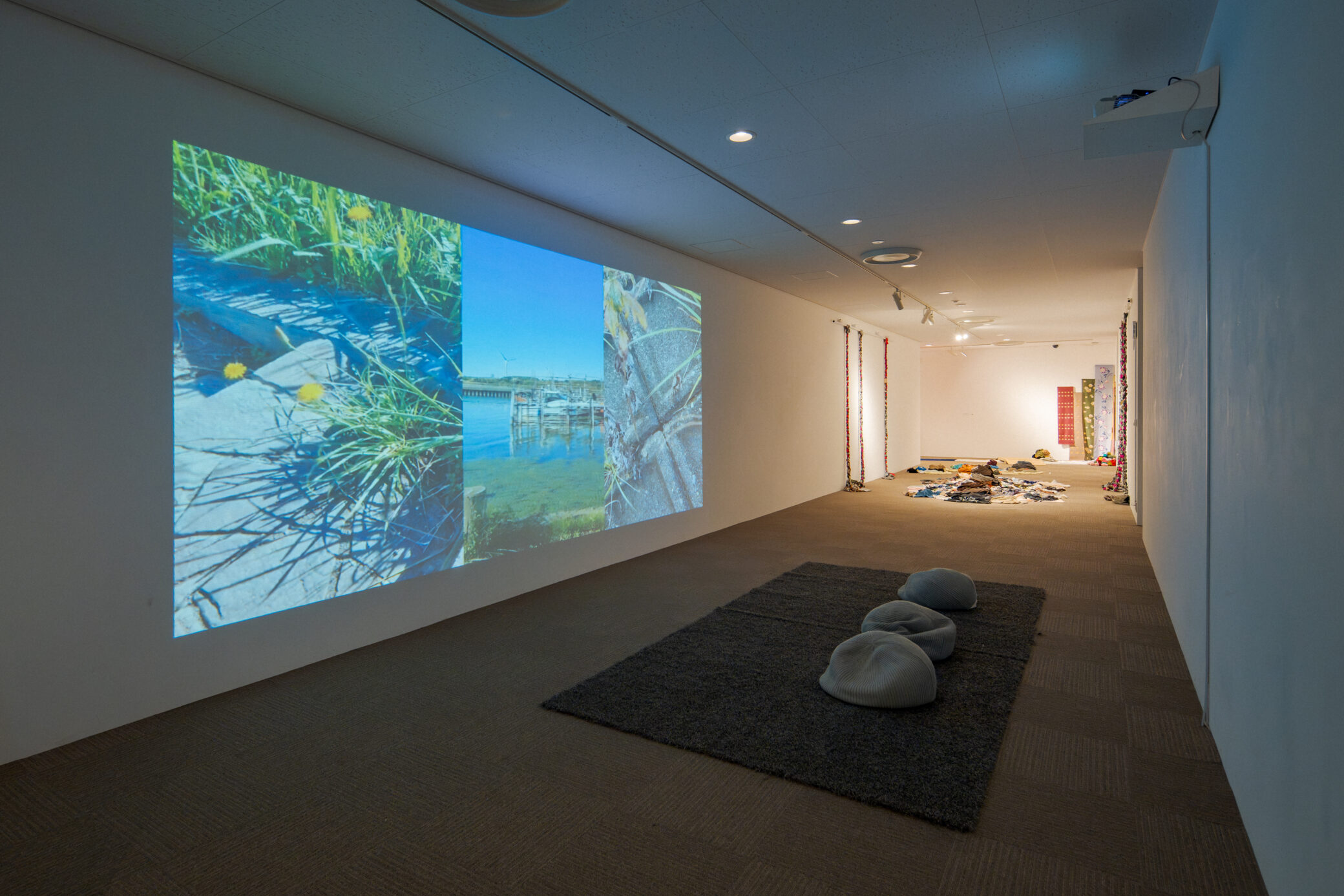
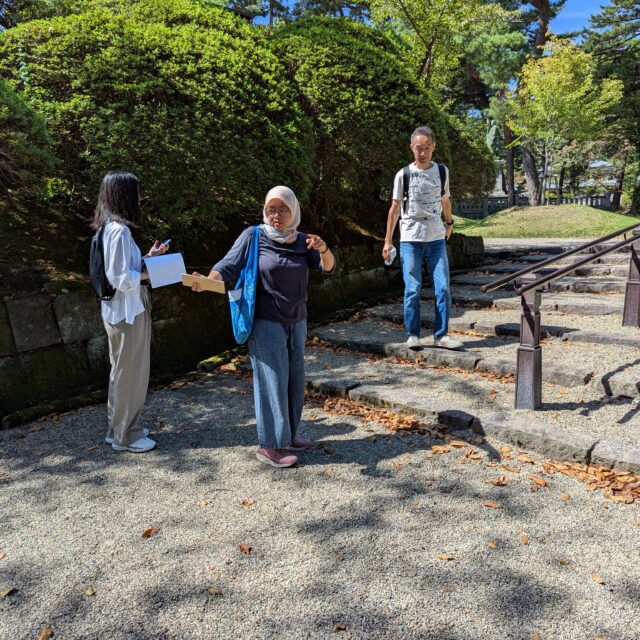
今回のプロジェクトにおいて加えて特筆すべきは、ワークショップ参加者と作家の間の記憶の交換行為である。フィトリアニは、故郷のインドネシアで自らが大切にしている風景の写真を素材に自身が制作したコラージュ作品を、参加者のコラージュ作品と交換し、持ち帰ってもらうことにした。いわば、記憶を交換する儀式のようなこの行為を重要なものとして位置付けた。さらに、ワークショップ終了後、フィトリアニは、参加者から寄せられた「風景の記憶」にまつわる場所を中心に、秋田県内の50箇所以上を訪れた。今回の成果展示の中でも、フィトリアニが訪れた場所が映像で紹介された。
日本各地の美術館やアートセンターなどでのプロジェクトにおいて、外から訪れた多くの作家が地域住民と交流し、作品の制作を行ってきた。一方で、会期終了と共に多くの作品は撤去されてしまうことで、作家と住民の間に築かれた関係性は、写真やテキストなどのドキュメントにのみ残る事例も多い。こうした状況を鑑みつつ、フィトリアニと市民の間の作品の交換行為や、風景の追体験の試みを捉えてみたい。そこには、秋田の人々の記憶を作品のための素材として消費するのではなく、対等な関係性を築きたいという作家の思いと、秋田の土地に何を残せるかという問いに向き合った、真摯な姿勢が示されている。
(C)2025 Rakhmi Fitriani
おわりに
本プロジェクトの参加者や、成果展示の鑑賞者は、秋田の街並みや自然が辿った工業化・近代化の過程、そして「今はもう戻ることのできない風景」がかつて存在した事実に否応なく直面することとなったであろう。しかし、フィトリアニにとって時間の中での風景の変化は自然なものであり、人間もまたその過程の一部にすぎない。彼女が今回のワークショップで意図したのは、単にノスタルジーを呼び起こすことや近代化を否定することではない。そこでの目的は、風景の変化を受け入れ、まさに慣れ親しんだ風景の記憶を編みなおすように、生活を営む環境に対する新たな視点や捉え方を促すことにあった。 ランドスケープアーキテクトの仕事においては、数十年後の樹木の生長や生態系の持続可能性までを見据えた、長期的な時間軸で環境と向き合うことが求められる。風景の変容をひとつの自然なプロセスとして捉えるフィトリアニの姿勢は、彼女が常にマクロな視点を持ちつつ、私たちが生きる世界と向き合ってきたからこそのものだ。秋田の人々にとって、フィトリアニとの活動の「記憶」は、日常の風景を多層的な時間軸の中で捉え直すための装置として、この先も作用し続けていくだろう。
撮影:星野 慧
Profile
佐々木蓉子(弘前れんが倉庫美術館 アシスタント・キュレーター)
1994年北海道札幌市生まれ。2020年北海道大学文学研究科(芸術学)修了。2020年から弘前れんが倉庫美術館に勤務し、地域に開かれた美術館のあり方に関心を持ちながら展覧会企画、コレクション管理に携わる。展覧会「ニュー・ユートピア——わたしたちがつくる新しい生態系」(2025年)では、津軽地方の「こぎん刺し」資料の展示などを担当。
▶︎プログラム全体の詳細についてはこちら
▶︎成果展示の詳細についてはこちら
Creator in Residence 2025 “Tapestry of Landscape” — Review by Yoko Sasaki
Creator in Residence 2025 began in September 2025. Guest creator Rakhmi Fitriani presented the results of her project “Tapestry of Landscape” at Akita City Cultural Creation Center from October 19 to 31. Yoko Sasaki, who served as the interviewer for Fitriani during the artist talk held on October 25, reflects on the project.
Residency Period: September–October 2025
Project Presentation: October 19–31, 2025
Artist Talk: October 25, 2025
Venue: Akita City Cultural Creation Center
Reweaving Landscape Memories: Reflections on Rakhmi Fitriani’s Residency
By Yoko Sasaki (Assistant Curator at the Hirosaki Museum of Contemporary Art)
Introduction
Rakhmi Fitriani is a landscape architect and artist based in Pangalengan, south of Bandung, Indonesia. During her residency in Akita, which began in September 2025 and lasted for approximately two months, Fitriani carried out a project entitled “Tapestry of Landscape.” This project largely consisted of 8 workshops in which she joined with local residents to create collaborative artworks, which were then presented at a Results Exhibition. In the following report, I look back on Fitriani’s activities in Akita and examine the artistic stance informing them, based on what I learned from the Results Exhibition and the talk event which I moderated as part of this project.
Workshop in progress
Beginnings as a landscape architect
Before beginning her artistic career, Fitriani worked as a landscape architect. Landscape architects collaborate with professionals in other sectors such as construction and civil engineering to design a wide range of landscapes, from gardens to public squares to parks, while taking into account factors like the flow of foot traffic and plant growing environments. Since graduating from the Landscape Architecture program of IPB University in 2016, Fitriani has been involved in several projects within Indonesia. She has stated that, while her role as a landscape architect has allowed her to gain a deeper knowledge of landscape design, it has also given rise to an inner conflict, as the imperative to modify the natural world to create landscapes that suit the desires of her clients has contributed to environmental destruction. Behind this imperative lies a Western conception of nature which is intimately connected to the field of landscape design, a conception which apprehends the natural world as something to be controlled. The disconnect between this Western conception of nature and Fitriani’s artistic conception of the “relationship between humans and nature” was one of two catalysts which set her on the path to becoming an artist, the other being her desire to go beyond the purely scientific knowledge of things like soil and climate which landscape architects are required to have, and to perceive the world in a more multi-layered way.
Tapestries of landscapes
The idea of “landscape memories,” the theme of Fitriani’s residency, was inspired by Shourideh C. Molavi’s Environmental Warfare in Gaza (2024, Pluto Press). The book is an investigation of the Israeli military’s impact on the natural environment of war-ravaged Gaza and the ways that conflict has reshaped the landscape of the narrow strip. Reading this book, Fitriani began to consider the question of how the interaction between landscape and people shapes our communal memories, cultures, customs, and values.
Fitriani has been creating artworks using embroidery and knitting techniques since 2019. Her residency project also mainly utilized such handicraft techniques, which she has been familiar with since childhood. According to Fitriani, the formative experience of her creative life was hand-sewing clothes for the dolls that her mother had bought for her, and she continued to enjoy knitting as a self-taught hobby during her university days. The thread and fabric materials themselves are made from plants, which are part of the nature that makes up the landscapes she has been engaged with as a landscape architect. This, too, is an important reason why she utilizes embroidery in her artworks.
The Results Exhibition was held in Studio A3, a corridor-like exhibition space on the third floor of the Akita City Cultural Creation Center (ACCCC). “Tapestry of Landscape,” consisting of collage works created by local residents who participated in the workshops, was displayed on the wall at the start of the exhibition route which ran along the corridor. During the workshops, a total of 59 participants brought in photographs of landscapes which held sentimental value; as they chatted with Fitriani, the participants used these photographs as the thematic bases for their collages. The participants also provided old fabric and clothing to use as the collage materials. For Fitriani, these donated fabrics were special materials that had experienced the landscapes of Akita together with the people who had provided them. A variety of collages were created, including some with stitching applied directly onto printed copies of the photographs, and others with fabric scraps of different textures sewn together to create frames around the photographs.
Between the collage works, present-day photographs (taken by Fitriani) of locations associated with the “landscape memories” provided by the participants were displayed alongside photographs of the same locations taken in the past. The photographs of these past landscapes were taken between the Meiji (1868-1912) and Showa (1926-1989) eras, and were collected by the artist herself from local historical archives found through libraries and other resources. In one example, a photograph showing a view of present-day downtown Akita City from inside Senshu Park, not far from ACCCC, was displayed on the wall next to a Showa-era photograph capturing the view from the same location. Yellow stitching runs lightly across the latter photograph like a winding road, as if linking the past with the embroiderer living in the present. Photographs of various other locations were displayed, ranging from familiar local mainstays like the venerable Kinouchi department store (established during the Meiji era) to scenes of natural beauty on the outskirts of the city.
Along with photographs, Fitriani invited local residents beyond those participating in the workshop to submit anecdotes related to specific landscapes in Akita – in other words, their “landscape memories.” These submissions ultimately involved a total of 72 distinct locations, which were introduced at the end of the exhibition route by handwritten notes from the participants, and even published to Google Maps. For Fitriani, this project was a mapping of the landscape memories of the people of Akita. In some cases, photographs of the same location (such as Kinouchi) were submitted by multiple participants, revealing how such individual landscape memories overlap to weave together the collective memory of the city. The artist attempted to represent this metaphysical process visually by integrating it into the physical process of weaving a single tapestry over a long period of time.
The time of flowing water
Just past “Tapestry of Landscape” was a space softly partitioned from the exhibition area by several pieces of sheer, transparent fabric, which hung down from the ceiling like curtains. A table and chairs were set up in this space for Fitriani and the local residents to work together. A roll of blue fabric was spread out on the table, and materials and tools for handicrafts were prepared. Fitriani visited this space regularly during the exhibition period to interact with the local residents, who would stop by of their own accord to chat and work on their embroidery, even when the artist was absent. As the portion of blue fabric spread across the table was filled up with decorations, the roll was gradually fed out onto the floor in a straight line, like a flowing river.
Beyond this collaborative working space lay a section of corridor where long, layered lengths of fabric hung along the wall from a position near the ceiling, recreating a flowing waterfall. This image was inspired by one of the submitted landscape memories, an anecdote concerning the subterranean river that feeds the Mototaki Waterfall in Nikaho City, located in the south of Akita Prefecture. On the floor nearby, fabrics were laid out to mimic the routes of the Omono, Asahi, Taihei, and Iwami rivers that flow through Akita City, unfolding like a map of the region. Finally, braided strips of old fabric ran down the surrounding walls. Taken together, these various elements created the impression of several winding rivers flowing through the entire studio. As waterfalls and rivers share the same source, deep within the mountains, the artist chose to emphasize their interrelatedness by joining them together within a single exhibition space.
Fitriani has repeatedly incorporated such images of “flowing water” into her artworks. One example is her 2022 work “Living Water,” which was created during a residency in Yogyakarta. This work focuses on how tourism development and agricultural activity in areas near the region’s nature preserves have brought about environmental changes which have altered the flows of springs and sources of lake water, impacting the lives of the people who live in those areas. Using fabric and yarn, the work expresses the transformation of these complex waterflows through intricate embroidery. Fitriani sees the water that flows through a given land as something which is closely intertwined with the daily lives of the local residents, a symbol of the interaction between the natural and human worlds. She also feels a connection between the flow of water and the techniques of handicrafts in terms of a sense of time, its cyclical, undulating flow evoked by the repeated physical motion of moving a needle up, down, and up again through a piece of fabric. She perceives the passage of time in the act of crafting as resonant with the flow of water, ceaselessly advancing as it surges up and down.
Photo: Rakhmi Fitriani
Exchanging memories
The exchange of memories between the artist and the workshop participants was another noteworthy element of this project. Fitriani prepared her own collages using photographs of cherished landscapes from her hometown in Indonesia, exchanging these for the participants’ collages and having them take hers home with them. It was, in a sense, a ritual of memory exchange, an act which she viewed as highly significant. In addition, following the conclusion of the workshops, Fitriani visited over 50 locations around Akita Prefecture, focusing on the locations associated with the “landscape memories” submitted by the participants. Later, during the Results Exhibition, she introduced these locations using the video footage she took at each one.
Most visiting artists at art museums and art centers across Japan carry out projects that involve interacting with local residents and producing artworks. However, at the end of such projects, these artworks are usually removed, and the relationships that were built between the artists and the locals survive only through photographs, texts, and similar documents. This is the context in which I wish to consider Fitriani’s exchange of artworks with the local Akita residents, and their attempts to vicariously experience each other’s landscapes. For it is here that the artist’s sincere stance is revealed: she is not consuming the memories of the people of Akita as mere material for her artwork, but rather seeking to build an equal relationship with them, while confronting the question of what she can leave behind in their land.
(C)2025 Rakhmi Fitriani
Conclusion
The project participants and exhibition visitors were likely forced to confront the industrializing and modernizing processes which have shaped the cityscape and nature of Akita, as well as the unavoidable fact that “landscapes which can never be returned to” did indeed once exist. For Fitriani, however, such changes in the landscape over time are natural phenomena, and we humans are merely one part of this process. She did not intend for the workshops to simply evoke nostalgia or reject modernity. Rather, their purpose was to encourage new perspectives and ways of thinking about the environment in which we live, so that we can embrace such changes, as if re-weaving the memories of once-familiar landscapes. The work of a landscape architect requires engagement with the environment over a long-term timeline, taking into consideration things like the growth of trees and the sustainability of ecosystems decades into the future. Seeing the transformation of landscapes as a natural process, Fitriani’s approach stems precisely from the fact that she has always managed to maintain a macro perspective as she engages with the world we live in. For the people of Akita, it is my hope that the “memories” of their activities with Fitriani will continue to function as mechanisms for re-imagining their everyday landscapes within multi-layered timelines.
Translated by Ethan Sames
Photo: Kei Hoshino
Profile
Yoko Sasaki Assistant Curator at the Hirosaki Museum of Contemporary Art
Born in Sapporo, Hokkaido in 1994. Completed her M.A. in Aesthetics/Art Studies at Hokkaido University in 2020. Since joining the museum in 2020, she has been involved in exhibition planning and collection management, with an interest in how museums can engage with their local communities. The Exhibition New Utopia: The New Ecosystem We Create (2025), she was responsible for displaying kogin-sashi embroidery materials from the Tsugaru region.
▶︎ For details about the overall program, click here.
▶︎ For details about the results presentation, click here.